The Council of Azmar
Contents
Overview
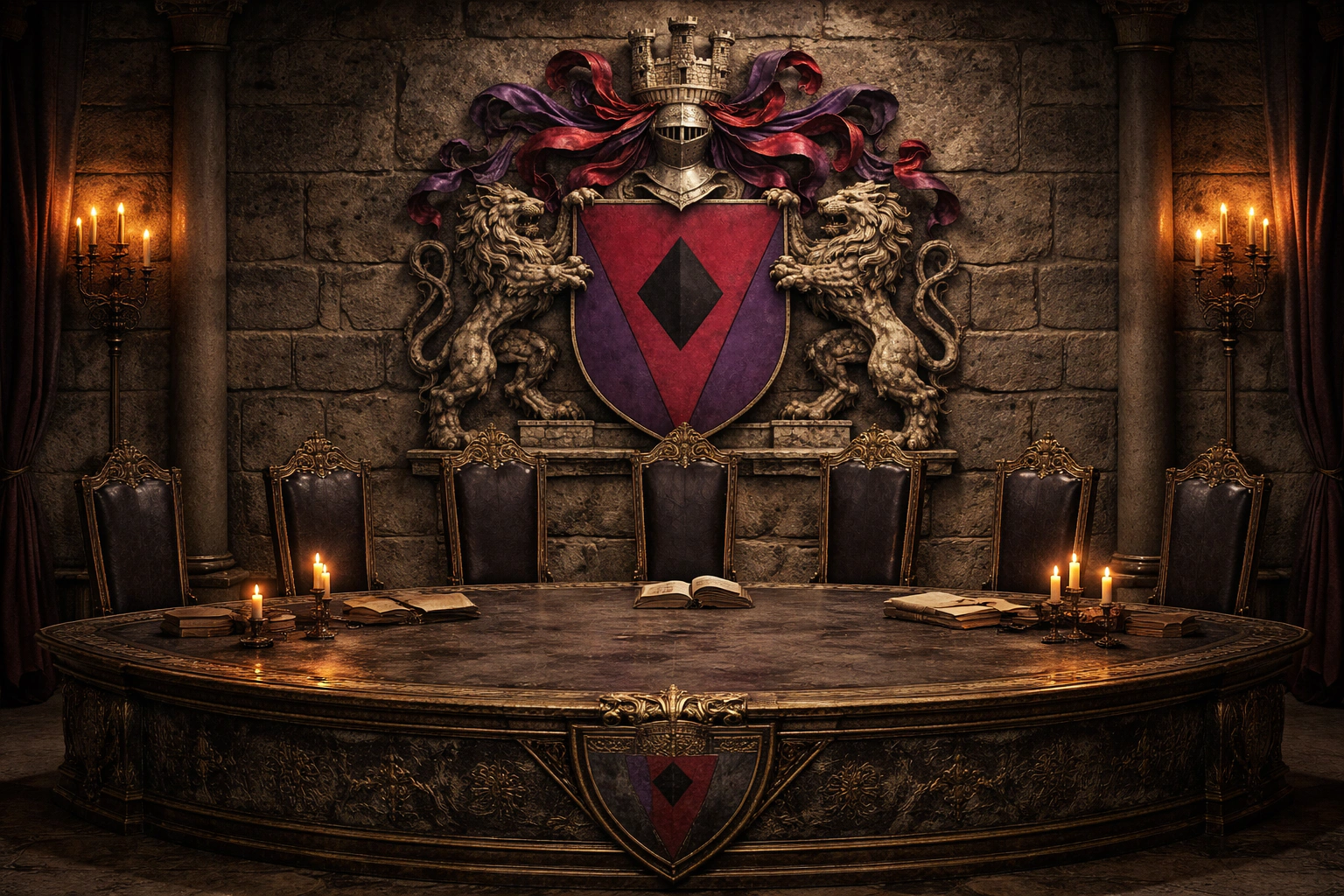
The Council of Azmar is the supreme deliberative body of the Azmarian Republic, seated in the Council chambers of Azmar, the Republic's capital. It consists of representatives from seven distinguished families — the Great Houses — each of which holds a specific governmental office covering a distinct area of law and governance. The Council has governed the Republic for over eleven hundred years, making it one of the oldest continuously functioning democratic institutions on Boriel.
The Council's defining principle is the distribution of power. Each House operates from a designated settlement rather than the capital, ensuring that political authority remains spread across the Republic's twenty-three settlements. The capital, Azmar, serves as shared ground where the Houses convene — no House is meant to rule from it permanently. This decentralisation prevents any single settlement or family from dominating the others and ensures governance reflects the Republic's geographic and cultural diversity.
The seven current Houses are Arno, Astra, Bronzebraid, Lampshire, Osteco, Pinespark, and Visk. Citizens across the entire Republic vote families into specific offices, not just their home territories, creating a system that balances regional and functional representation.
Origins & History
The Founding Alliance
The Azmarian Republic was founded approximately 1,132 years ago, when the independent city-states and free towns of the region — each governed by its own noble family — agreed to form a mutual defence pact and comprehensive trade agreement. The catalyst was twofold: the need for coordinated defence against external threats, and the economic inefficiencies of operating as isolated settlements.
What began as a practical alliance gradually evolved into a shared identity and collective governance structure. The noble families agreed to coordinate military efforts, standardise trade practices, and establish common laws. In its earliest years, the alliance functioned as a council of noble families making decisions collectively.
Evolution of the Council
The Council has not always consisted of seven families. In The Azmarian Republic's early years, more families held seats, each representing different cities and interests. Over the centuries, the composition changed through a combination of political manoeuvring, demographic shifts, and legal reform. Some noble lines died out without heirs. Others lost the confidence of the citizenry and were voted out of power. Legal changes refined which offices were necessary and how power should be distributed.
The current seven Houses represent those who have proven most capable of maintaining public support, adapting to changing times, and effectively governing their offices. The possibility of being voted out ensures that even ancient Houses must continue to serve The Azmarian Republic's interests or risk losing their positions.
Two relatively recent additions illustrate this ongoing evolution. House Bronzebraid was among the first Dwarven clans to fully integrate into The Azmarian Republic's governance, demonstrating the system's openness to different races in positions of power. House Osteco arrived more recently still, a Moon Elf family who left the Teu-tel Triumvirate to establish the settlement of Moonshore within The Azmarian Republic.
Structure & Function
The Council operates through a system of Offices. Each House holds responsibility for a specific portfolio of governance — commerce, law, defence, and so forth — and exercises that authority Republic-wide while also governing their home region. This creates a dynamic where some Houses govern larger territories than others depending on geography, while wielding influence proportional to the significance of their office.
The Council convenes in the chambers at Azmar. Decisions require deliberation among all seven Houses, and the system is designed so that no single House can dominate proceedings. Rosalie Astra of House Astra is considered by many to be the head of the Council, though this is a de facto position stemming from House Astra's role as constitutional authority and legal arbiter, rather than a formally defined rank of superiority.
Civilian control of the military is maintained by having the Tusked Host answer to House Lampshire and ultimately to the full Council, rather than operating as an independent force.
The Seven Great Houses
House Arno
A prominent merchant family governing the port city of Arbernor, House Arno has risen to power through their extensive trading network. Led by Sefona Arno, a Half-Elf known for her sharp mind and keen business acumen, the House holds the Office of Commerce, Trade & Agriculture. Sefona ensures that trade and agricultural policies benefit the Republic and its citizens, bringing diplomatic skill and cultural patronage to the Council.
House Astra
Renowned for their grand library and their role as historians and lawbringers, House Astra holds the Office of Law & Justice and serves as the Republic's constitutional authority and legal arbiter. Led by Rosalie Astra, a human considered by many to be the head of the Council, the House guides the Republic with wisdom and a deep understanding of its history and legal precedent. House Astra is also noted for its mastery of celestial navigation and astronomical research. Their designated seat is Avistar, though Rosalie has controversially begun conducting more business from the capital — see Current Controversies.
House Bronzebraid
Led by Mormond Bronzebraid, a Dwarf and steadfast leader, House Bronzebraid was among the first Dwarven clans to join the Republic. The House holds the Office of Resources, Industry & Finance, managing the Republic's mineral wealth, industrial production, and financial systems from the mining towns of Kingsmound and Scarhill. The Bronzebraids are renowned craftspeople and metallurgists, representing the interests of mining communities and industrial innovation while maintaining the Republic's economic stability.
House Lampshire
Dwelling in the frontier town of Wickton, House Lampshire is led by Perrich Lampshire, a Halfling known for exceptional mediation skills. The House holds the Office of Defence, Military Relations & Transport, responsible for maintaining harmony between the Council and the Tusked Host, overseeing military matters, and ensuring the security of the Republic's roads and safe travel. Perrich's diplomatic abilities bridge the gap between civilian governance and military necessity, while coordinating road patrols and transportation security that keeps commerce flowing safely.
House Osteco
The most recent addition to the Council, House Osteco is led by Lothal Osteco, a Moon Elf who left the Teu-tel Triumvirate to establish Moonshore within the Republic. The House holds the Office of Foreign Relations & Cultural Affairs, managing diplomatic relations with other nations and organising major festivals and cultural events. While also renowned agricultural experts who share valuable Moon Elf farming techniques, governmental authority over agriculture falls under House Arno's portfolio. House Osteco's focus on diplomacy and cultural exchange makes them invaluable in fostering international relationships and celebrating the Republic's diversity.
House Pinespark
Led by Nigel Pinespark, a human ruling from Wolfpine, House Pinespark holds the Office of Environment & Maritime Affairs. Known for deep connections with the druid clans of Mythwood and expertise in medicine and shipbuilding, the family also conducts significant business from Salsgate where their knowledge directly supports the shipbuilding industry. House Pinespark champions sustainable practices while maintaining the balance between development and preservation of natural resources, and oversees the Republic's relationship with the sea.
House Visk
Led by Arlo Visk, a human ruling from Ebonkeep, House Visk holds the Office of Education & Magical Affairs, overseeing the Republic's schools, universities, libraries, and regulation of magical practices. The House maintains the Scriptorum Sanctorum — a premier institution for magical research that exists both in Ebonkeep and within a pocket dimension — as well as a unique network of portal-connected outposts enabling instantaneous travel for mages and authorised individuals. The Scriptorum's Aetherial Vault secures dangerous artefacts, while its Library of Arcane (staffed by intelligent owls) preserves magical knowledge. Despite personal tragedy — the loss of his wife and child during a goblin attack — Arlo continues to lead with a focus on advancing the Republic's knowledge and magical capabilities.
Democratic Principles
While the Council provides leadership and direction, the Republic's democratic structure ensures that citizens have a meaningful voice in governance. Families are voted into specific offices by citizens across the entire Republic — not just their home territories — and the possibility of being voted out prevents complacency among even the most established Houses.
Representatives are also elected from various districts and communities to voice concerns, propose legislation, and shape policies. This participatory system fosters a strong sense of community and collective responsibility, distinguishing the Republic from its more autocratic neighbours such as the Serell Ascendency and the feudal monarchy of Eldoria.
Current Controversies
Ongoing Dispute
House Astra's relocation to Azmar. House Astra has increasingly conducted business from the capital rather than their designated seat of Avistar. This has raised concerns among other Houses and the citizenry, as it conflicts with the Council's founding agreement that no family would "rule" from the capital — Azmar was established as equal ground for all. Critics argue this concentrates too much influence in one place and undermines the principle of distributed power. Supporters counter that proximity to the Council chambers allows Rosalie Astra to fulfil her role as legal arbiter more effectively.
Externally, the Council faces growing pressure from The Serell Ascendency, which has increased military presence along the western border and raised tariffs on trade through Phantom's Path in the Menstone Mountains. The Rotten Wilds surrounding the abandoned settlement of Helta continue to block what was once a major trade corridor to the southeast, requiring constant garrison vigilance from House Lampshire's forces.